Time = Life: Why Reliable In‑Building Communication Can’t Wait

Every second counts. The FCC estimates that shaving just one minute off emergency response times could save 10,000 lives each year. In a crisis, that minute is often lost inside the building—where wireless “dead zones” block 9‑1‑1 calls, drop alerts, and prevent first responders from communicating clearly. When communication breaks down, lives are at risk.
This isn’t hypothetical. There are over 6 million commercial buildings in the U.S., and many still can’t guarantee reliable indoor signal when it matters most. Schools are especially vulnerable—because a single missed call can change everything.
What “Reliable In‑Building Communication” Really Means
It’s more than bars on a phone. A resilient safety communications environment includes:
- 9‑1‑1 that works indoors: Staff, students, and visitors must be able to place and receive emergency calls and texts anywhere on campus.
- First responder radio coverage (ERCES/ERRCS): Fire, police, and EMS need clear, instant radio communications inside and out.
- Panic buttons that perform: Alyssa’s Law–compliant silent alarms must reach law enforcement immediately—no delay, no single point of failure.
- Mass notification that reaches everyone: Real-time alerts that reliably deliver instructions during fires, medical events, or active threats.
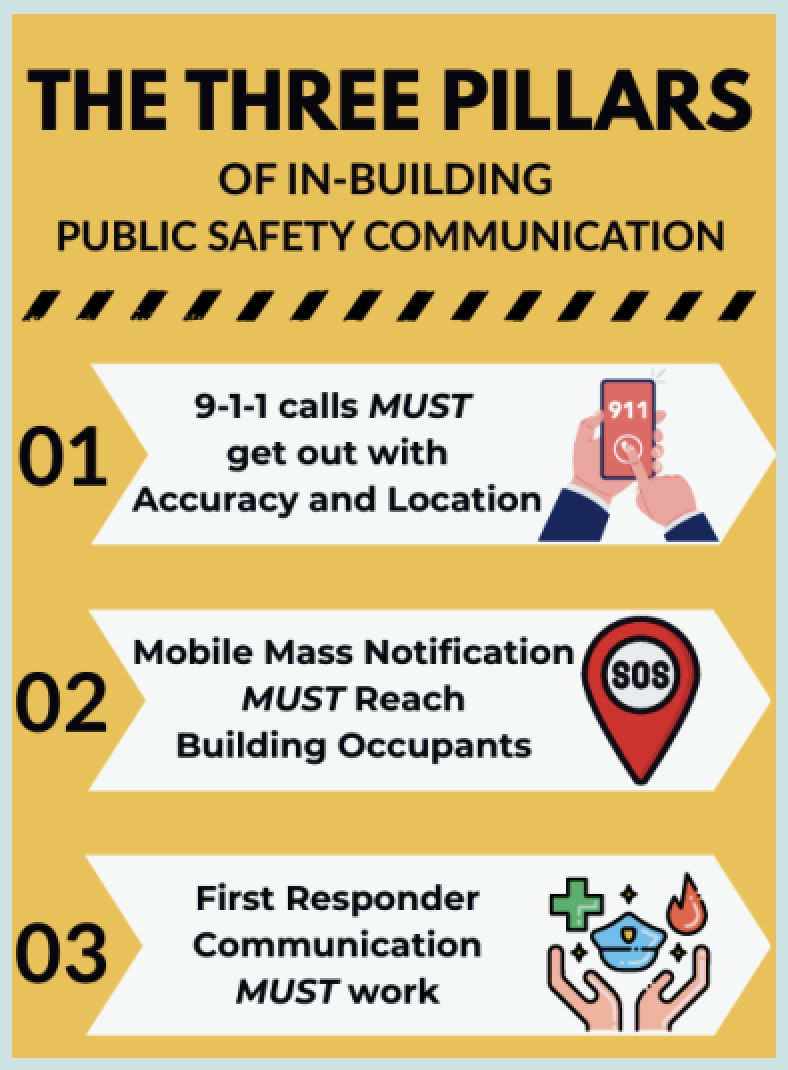
To make all of this work under stress, schools need engineered coverage, hardened pathways, backup power, and integrated wired/wireless networks that don’t fail when the grid does.
Why Schools Can’t Wait
- Time = Life: In an emergency, there may be one chance to connect—and no time to try again.
- Alyssa’s Law momentum: Several states already require panic buttons that connect directly to law enforcement; as of June 2025, states including NJ, FL, NY, TX, TN, UT, OK, WA, OR, and GA have acted. More are moving forward.
- Compliance expectations: Many jurisdictions enforce in‑building radio coverage and related safety communications as part of occupancy and ongoing operations.
Codes, Standards, and Rules You’ll Hear About
- IFC Section 510: Emergency responder radio coverage inside buildings.
- NFPA 1225 (with references to NFPA 72): Performance, inspection, testing, and maintenance for ERCES.
- UL 2524: System-level listing for two-way emergency radio communication enhancement systems.
- FCC 47 CFR 90.219: Signal booster rules to protect public safety radio networks from harmful interference.
Bottom line: Systems must be designed, installed, tested, and maintained to meet both safety performance and regulatory requirements.
Engineering for Reliability (So Seconds Aren’t Lost)
- Provide proven RF coverage: Design ERCES/ERRCS with proper donor links, BDAs, antennas, coax/fiber runs, and isolation to deliver code-required signal and intelligibility.
- Eliminate “noise”: Use no-noise practices, quality components, and proper grounding/shielding to prevent uplink/downlink interference.
- Ensure pathway survivability: Where required, use 2‑hour rated pathways, plenum-rated cabling, and protected enclosures/conduit.
- Power through the outage: Battery and standby power for head-end, remotes, BDAs, and network gear so alerts and radios keep working.
- Test like it’s real: Perform grid testing, document results for AHJs, and implement ongoing inspection, testing, and maintenance.

What You Can Do Today
For parents
- Ask: Can our school make and receive 9‑1‑1 calls everywhere indoors? Do panic buttons and alerts work campus-wide—even during an outage?
- Take action: Contact your representatives and share resources with PTA and community leaders.
For educators and staff
- Report gaps and near‑misses to administrators and safety teams.
- Partner with parents and local officials to prioritize in‑building coverage testing and upgrades.
For legislators and district leaders
- Treat school safety as a nonpartisan priority.
- Adopt legislation with funding and streamlined compliance pathways.
- Require performance-based testing and ongoing maintenance.
For facility, safety, and IT leaders
- Commission an in‑building coverage assessment (cellular and public-safety radio).
- Align designs with IFC 510, NFPA 1225, UL 2524, and FCC 90.219.
- Budget for backup power, pathway survivability, and annual testing.
How Windy City Wire Helps
Reliable systems start with reliable infrastructure:
- Purpose-built cabling: Low-PIM coax, fiber, hybrid, and power cabling with proper listings (plenum), shielding, and identification (often red for public safety).
- Survivability solutions: Options for 2‑hour rated pathways and hardened routing per AHJ requirements.
- Documentation that passes review: Spec sheets, listings, bend radius, attenuation, and installation guidance that integrators use for submittals and closeout packages.
We collaborate with integrators and AHJs to help schools move from assessment to approval—faster and with fewer surprises.
For detailed product information and additional resources on distributed antenna systems, visit the DAS Resource Center. For questions or specification requests, reach out through the contact page.
Make the Call—Before You Need to Make the Call
- Learn and act: saferbuildings.org
- Support Alyssa’s Law advocacy: MakeOurSchoolsSafe.org
- Build resilient infrastructure: windycitywire.com
